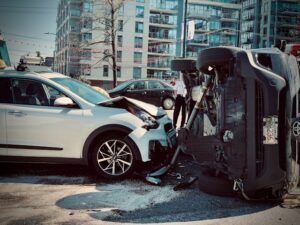
Statistics from the National Highway Traffic Safety Administration show that in 2024, there were 6,228 deaths caused by motorcycle crashes. This figure made up roughly 16% of the traffic-related fatalities in the US.
On the whole, drivers are much safer than motorcyclists. Every mile a driver drives comes with an even lower risk of dying in a crash. Motorcyclists, on the other hand, face a fatality rate per mile traveled almost 27 times that of passenger car occupants.
Examples of common causes of motorcycle accidents are distractions on the road, drivers speeding, making dangerous lane changes, or drivers running red lights or not stopping when others have the right of way. Drivers also commonly do not pay enough attention to notice motorcycles.
The level of recklessness or negligence on the road has an impact on liability for damages caused by the accident. Drivers can prevent such damages and the possibility of injuries by using proper defensive driving techniques. Pinpointing the exact cause of an accident is essential for assessing legally responsible parties.
Let’s take a closer look at the common reasons for motorcycle collisions.
The Left Turn Across the Rider’s Path
There is one specific case that appears prominently in two-vehicle collisions. As reported by the NHTSA, in 45% of fatal two-vehicle collisions with a motorcycle in 2024, the other vehicle was making a left turn and the motorcycle was going straight, passing, or overtaking.
It would be easy to understand how such an incident could happen. A motorist who wishes to turn left looks out for other motorists that are coming from the opposite direction, spots a gap, and turns left.
Unlike automobiles, motorcycles can be lost within a narrow area because of their smaller size. For example, a single motorcycle could be lost behind a roof support, a side mirror, or a glare off of a windshield.
Intersections and driveways produce the same problem on a smaller scale. A car pulling out of a parking lot or switching lanes without a proper head check can close a rider’s escape route in less than a second.
Motorcycle accidents may arise as a result of road hazards, bad weather, mechanical faults, negligence, and drunk driving. The environment may pose further danger to motorcyclists since they are more vulnerable to environmental conditions like strong winds, loose stones on the road, and debris on the road compared to passengers in cars.
According to a Michigan motorcycle accident lawyer, state law permits an injured rider to sue the party that caused the crash in certain circumstances. If an accident caused death, serious impairment of body function, or permanent serious disfigurement, the victim is likely eligible to pursue a personal injury claim for noneconomic damages.
Speed and Alcohol
Rider responsibility is a factor as well. As per NHTSA statistics, 37 percent of motorcycle riders involved in fatal crashes in 2024 were speeding versus only 22 percent of passenger car drivers. Bikes accelerate to highway speeds within seconds, which gives riders incentive to try something they would not dare do in a car.
Approximately 25 percent of riders and passenger car drivers in fatal crashes were alcohol-impaired, with a blood alcohol concentration of .08 or higher. Consuming alcohol prior to riding negatively impacts riders’ judgment, balance, and reaction time and places riders at a higher risk of crashes.
Roads, Weather, and Machines
Many road hazards, like a single bump on the road, can disorient a motorcycle but don’t present a serious danger. Meanwhile, many situations that are harmless for cars can be dangerous for motorcycles. These include loose gravel, oil near stop signs, and freshly-applied tar. Because of the size and configuration of its wheels, a motorcycle can easily lose balance when traveling over road hazards.
In 2024, NHTSA reported that 24% of motorcycles involved in fatal accidents collided with fixed objects, compared to 16% of passenger cars.
The weather conditions can increase all of these hazards. Traction gets tricky with tires in wet conditions, foggy visibility can make driving unsafe, and winds on long open stretches can make driving a vehicle of any size unstable.
A mechanical problem completes the list. Tires, brakes, and bad repair can turn a casual drive into an emergency situation. The fault that originates from a manufacturer or repair shop opens a new track of liability after a fall.
Licensing and Helmets
The most significant statistics normally have little or nothing to do with the actual collision. According to NHTSA, 35 percent of all riders in fatal collisions in 2024 did not hold a valid motorcycle license.
Helmets don’t prevent accidents, but they affect who will survive them. This fact is proven by the difference between the 48% of fatally injured motorcyclists who weren’t wearing helmets in 2024 in states without universal helmet laws and the 11% in states with universal helmet laws.
Motorcycle accidents can occur for many reasons. Just before mounting a motorcycle, riders can do their part to substantially decrease the risk of being involved in an accident by checking traffic twice before a turn. Riders should also follow speed and sobriety laws and ride on a clean surface.