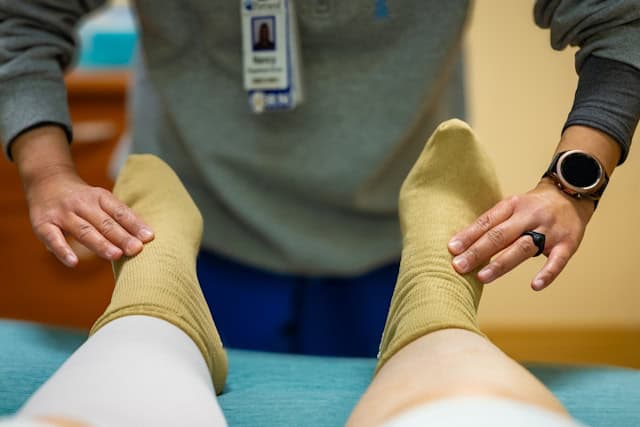

By the third trimester, a different kind of tiredness often starts to show up: the kind that lives in your legs. Not the exhaustion you can fix with a nap, but the heaviness that settles around your calves and ankles by mid-morning and stays there, tight and uncomfortable, for the rest of the day.
You keep moving because that is what you do, but somewhere in the background, you wonder why this part was not mentioned more often on the list of things to expect.
The answer is fluid retention, or edema, and it affects the vast majority of pregnant women at some point. It is not just uncomfortable.
It can make it harder to walk, harder to stand for long periods, and harder to feel present in your own body during a time that already asks a lot of you.
The good news is that maternity compression socks to reduce leg edema are one of the most accessible, evidence-supported tools available for managing this.
They are not complicated.
They do not require a prescription in most cases.
They simply work with your circulation to ease some of the weight your legs are carrying, and that can change the shape of your day in a meaningful way.
What is actually happening in your legs

During pregnancy, your body increases its total blood volume by around 30 to 50 percent to support your growing baby. That is a significant circulatory shift, and it puts real pressure on the veins responsible for returning blood from your legs back to your heart.
At the same time, your growing uterus presses on the large veins in your pelvis, further slowing that upward return. Progesterone, which relaxes smooth muscle throughout the body, also causes veins to become more pliable and less efficient at pumping blood back up against gravity. The cumulative result is fluid accumulating in the tissues of the lower legs, feet, and ankles.
This is not a sign that something is wrong. For most pregnant women, it is a completely normal physiological response. But normal does not mean you have to simply tolerate it. Taking care of your body during pregnancy including the parts that don’t get talked about as often as the bump — is one of the most practical acts of self-respect there is.
How compression socks actually help

Compression socks for pregnancy work on a straightforward principle. By applying graduated pressure, firmest at the ankle and easing as the sock rises toward the knee, they physically assist your veins in pushing blood upward.
This reduces the amount of fluid that pools in the tissue, which in turn reduces the swelling, heaviness, and that achiness that builds through the day.
Brands like Vim & Vigr have built their maternity compression socks to reduce leg edema specifically around this reality, pairing clinically appropriate graduated compression with designs that are genuinely wearable every day, making it easier to stay consistent with a tool that works best when you do not skip it.”
Research supports their use during pregnancy where they have shown that compression stockings reduced the risk of edema-related complications by around 25 percent in pregnant women.
They may also support venous health more broadly, lowering the risk of varicose veins and, in combination with other preventive measures, reducing the elevated risk of deep vein thrombosis (DVT) that pregnancy carries.
As always, speak with your midwife or doctor if you have concerns about circulation or any history of vascular conditions.
On an everyday level, what most women notice is simply that their legs feel lighter.
The tightening that starts building by lunchtime starts later, or does not build as much. The relief is not dramatic, but it is consistent, and consistency matters a great deal when you are already managing a lot.
What to look for in a maternity compression sock

Not all compression socks are built the same way, and buying the wrong pair can be counterproductive. Here is what to pay attention to:
- Compression level: For most pregnant women, 15-20 mmHg is the recommended starting point. This level of graduated pressure is enough to support circulation without feeling restrictive. Women experiencing more significant swelling, or with a clinical reason for higher support, may benefit from 20-30 mmHg, but this is worth discussing with your care provider first.
- Graduated compression only: Look specifically for graduated compression, which is tightest at the ankle and gradually reduces pressure up the leg. Uniform pressure socks, or socks with tight bands at the top, can actually worsen circulation by creating a tourniquet effect.
- Breathable material: Pregnancy often raises your body temperature, so moisture-wicking, breathable fabrics make a real difference to comfort. Nylon-spandex blends tend to hold their shape and compression level well. Natural fibre options like merino wool or bamboo blends are better for women with sensitive skin.
- Fit and sizing: Measure your calf at its widest point and your ankle circumference. Most brands provide detailed sizing guides. A sock that is too small will cut off circulation; one that is too large will provide no real benefit.
- Ease of wear: This becomes especially important as pregnancy progresses. By the third trimester, pulling on a tight sock requires real effort. Some brands design their socks specifically with ease of application in mind, which is worth considering.
- Style is also worth mentioning. Compression socks have moved well beyond the clinical beige of their medical origins. Brands like Vim & Vigr have built their entire identity around the idea that effective legwear should also be something you actually want to put on in the morning, with prints and textures that fit naturally into a pregnancy wardrobe rather than being hidden under it.
When to wear them and what to expect

The timing matters. The most effective approach is to put compression socks on first thing in the morning, before you stand up and before fluid has had the chance to start pooling. Once swelling has already set in, the socks still help, but they work harder from a disadvantaged starting position.
Wearing them throughout the day is fine, including during gentle exercise, errands, work, and travel. If you are flying during pregnancy, compression is especially useful because prolonged immobility in a pressurised cabin significantly reduces circulation in the lower legs.
For women in their second or third trimester particularly, wearing compression socks on any flight lasting more than an hour or so is a sensible precaution.
You can also sleep in them if your legs are cramping or aching at night, though for most women with mild to moderate swelling this is not necessary. The priority is consistent daytime wear. Combined with elevation when resting, staying hydrated, and regular movement breaks, supporting your body through what it is carrying is genuinely within reach, even in the final weeks.
A note on listening to your body
Swelling in both legs that builds gradually through pregnancy is usually a normal part of the process.
But sudden swelling, swelling in only one leg, or swelling accompanied by pain, redness, or skin warmth is worth flagging to your midwife or doctor promptly, as these can occasionally indicate a blood clot or other condition that needs attention.
The same goes for sudden swelling in your face, hands, or around your eyes, particularly if it comes alongside headache or visual disturbance.
These are warning signs of pre-eclampsia and require immediate medical attention. Compression socks are a support tool for normal pregnancy swelling, not a substitute for medical assessment when something feels unusual.
The bottom line
Heavy, swollen legs during pregnancy are real and they are genuinely uncomfortable. You are not being dramatic about it. Your body is managing a remarkable amount of extra work, and the lower limbs are often where that shows up most visibly.
A well-fitted pair of maternity compression socks will not fix everything, but they can take a meaningful edge off.
For a lot of women, that is the difference between managing the day and being exhausted by it. That is worth something.